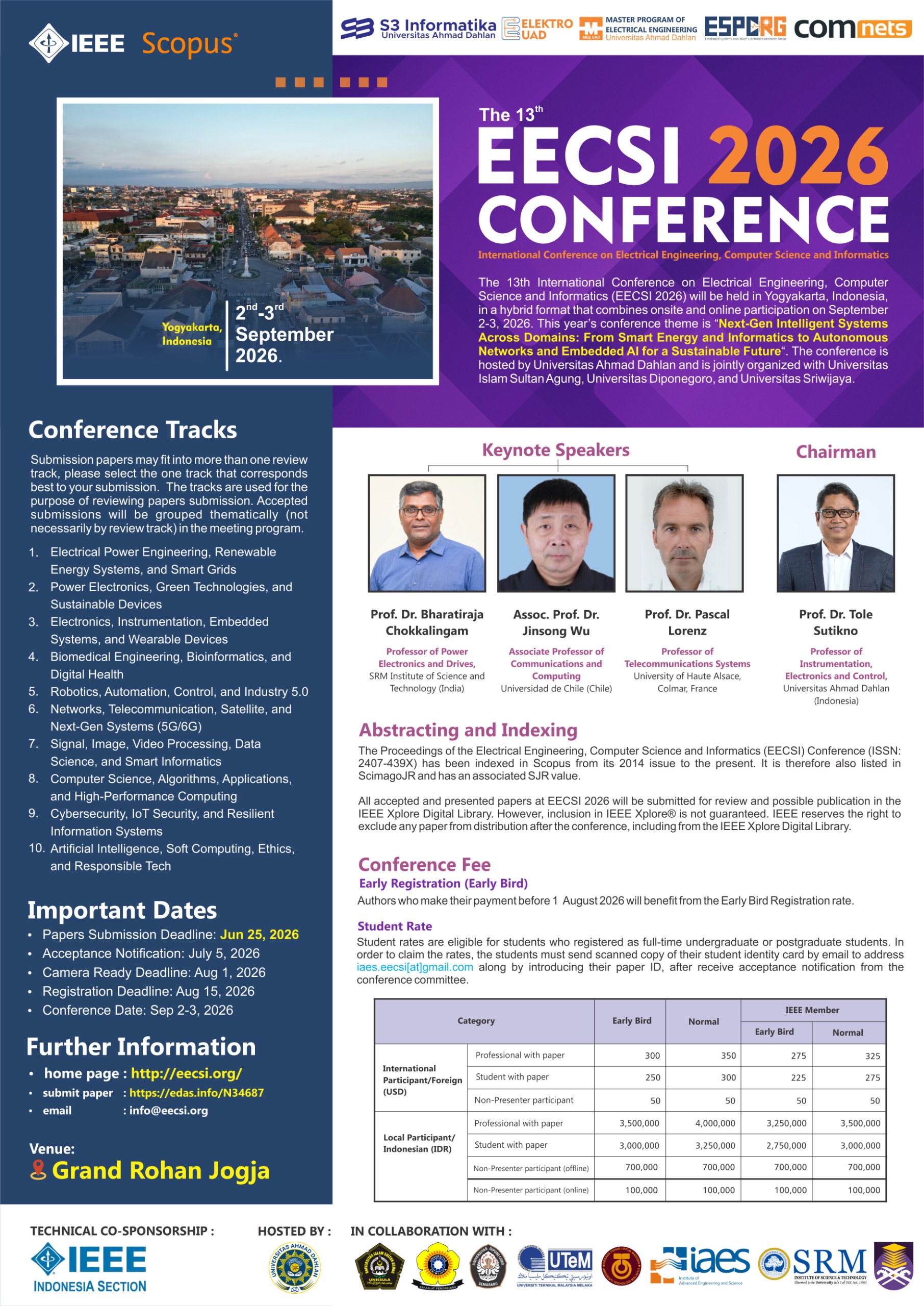
The 13th International Conference on Electrical Engineering, Computer Science and Informatics (EECSI 2026) will take place in Yogyakarta, Indonesia, on September 2–3, 2026, in a hybrid format that combines onsite and online participation. EECSI has established itself as one of the leading international conferences in the region, providing a premier platform for researchers, academicians, scientists, students, engineers, and industry practitioners to present their latest research findings, share innovative developments, and discuss applications across the broad spectrum of electrical engineering, computer science, and informatics.
EECSI 2026 will feature diverse conference tracks spanning smart electrical power systems, renewable energy, power electronics, electronics and instrumentation, robotics and automation, IoT, telecommunication networks, cybersecurity, blockchain, artificial intelligence, data science, and smart informatics, highlighting how next-generation intelligent systems can drive sustainable innovation and address global challenges in energy, industry, and digital transformation.
1. Electrical Power Engineering, Renewable Energy Systems, and Smart Grids
This track explores the transformation of traditional power systems into intelligent, sustainable infrastructures. It covers innovations in generation, transmission, and distribution, with emphasis on integrating renewable sources such as solar, wind, hydro, and biomass into modern grids. Topics include microgrids, distributed generation, demand-side management, energy storage technologies, and smart metering systems. Research contributions may address challenges in grid stability, resilience against cyber-physical threats, and policy frameworks for sustainable energy adoption. The track highlights how smart grids and renewable integration can accelerate the global transition toward clean energy while ensuring reliability and affordability.
2. Power Electronics, Green Technologies, and Sustainable Devices
Power electronics is the backbone of energy conversion and efficiency, enabling the deployment of green technologies and sustainable devices. This track covers converters, inverters, motor drives, solid-state devices, and advanced switching technologies applied to renewable integration, electric mobility, and industrial efficiency. It also emphasizes energy-efficient consumer electronics, smart appliances, and green industrial systems. Contributions may explore vehicle-to-grid technologies, fast-charging systems, wide-bandgap semiconductors (SiC, GaN), and sustainable design practices. The track demonstrates how innovations in power electronics support low-carbon transitions, enhance energy efficiency, and enable scalable solutions for sustainable development across industries.
3. Electronics, Instrumentation, Embedded Systems, and Wearable Devices
This track focuses on the design and application of electronic circuits, sensors, and embedded systems for diverse domains. Topics include instrumentation for industrial automation, IoT-enabled embedded platforms, microcontrollers, FPGA-based systems, and wearable devices for healthcare, fitness, and human–machine interaction. Contributions may highlight low-power design, edge computing, real-time data acquisition, and integration of electronics into smart environments. The track emphasizes practical implementations that bridge hardware innovation with societal needs, from medical monitoring and assistive technologies to industrial safety and consumer electronics.
4. Biomedical Engineering, Bioinformatics, and Digital Health
At the intersection of engineering and life sciences, this track highlights biomedical devices, computational biology, and digital health solutions. Topics include biosensors, medical imaging, bioinformatics algorithms, telemedicine platforms, and AI-driven diagnostics. Contributions may address personalized medicine, healthcare data analytics, wearable health monitoring, and digital health ecosystems that improve patient outcomes. The track encourages interdisciplinary research that combines engineering rigor with clinical applications, advancing healthcare accessibility, precision medicine, and innovation in global health systems.
5. Robotics, Automation, Control, and Industry 5.0
This track emphasizes robotics and intelligent automation systems for industrial and societal transformation. Topics include autonomous robots, advanced control systems, cyber-physical production systems, and collaborative robotics aligned with Industry 5.0 principles. Contributions may explore human–robot collaboration, sustainable manufacturing, adaptive control, swarm robotics, and robotics for healthcare, agriculture, and disaster response. The track highlights how automation and robotics can enhance productivity while maintaining human-centric design, resilience, and sustainability, positioning robotics as a driver of the next industrial revolution.
6. Networks, Telecommunication, Satellite, and Next-Gen Systems (5G/6G)
This track focuses on communication infrastructures and next-generation networks. Topics include 5G/6G architectures, satellite communications, wireless sensor networks, IoT connectivity, and emerging paradigms for global communication. Contributions may address spectrum management, network virtualization, edge computing, quantum communication, and AI-driven network optimization. The track emphasizes how advanced networks enable digital transformation, smart cities, autonomous systems, and global connectivity, bridging gaps between regions and industries while supporting the demands of future intelligent applications.
7. Signal, Image, Video Processing, Data Science, and Smart Informatics
This track explores data-driven technologies for multimedia and information systems. Topics include signal processing, image and video analysis, pattern recognition, big data analytics, and machine learning applications. Contributions may highlight computer vision, multimedia compression, intelligent information systems, and decision-support platforms. The track encourages interdisciplinary approaches that combine engineering, informatics, and data science to solve real-world problems in healthcare, industry, security, and entertainment, showcasing how smart informatics can transform data into actionable knowledge.
8. Computer Science, Algorithms, Applications, and High-Performance Computing
This track is dedicated to advances in computational theory, algorithms, and applications. Topics include optimization, distributed systems, software engineering, cloud computing, and parallel processing. Contributions may explore high-performance computing for scientific simulations, industrial applications, AI workloads, and large-scale data processing. The track emphasizes how computational innovations drive efficiency, scalability, and breakthroughs across domains, from climate modeling and bioinformatics to enterprise solutions and smart infrastructures.
9. Cybersecurity, IoT Security, and Resilient Information Systems
This track addresses the growing challenges of digital security and resilience. Topics include cryptography, intrusion detection, secure protocols, privacy-preserving technologies, and frameworks for building robust information systems. Contributions may focus on IoT ecosystems, network resilience, blockchain-based security, and strategies for mitigating cyber threats. The track emphasizes the importance of trust, transparency, and resilience in digital infrastructures, ensuring secure adoption of emerging technologies in smart cities, healthcare, finance, and industrial systems.
10. Artificial Intelligence, Soft Computing, Ethics, and Responsible Tech
This track highlights AI and soft computing approaches for intelligent problem-solving, alongside discussions on ethics and responsible technology. Topics include machine learning, fuzzy logic, neural networks, genetic algorithms, and probabilistic reasoning. Contributions may explore AI governance, fairness, transparency, bias mitigation, and sustainability in intelligent systems. The track encourages research that balances technical innovation with ethical responsibility, ensuring that AI and computational methods serve humanity in equitable, trustworthy, and sustainable ways.
Beyond technical sessions, EECSI 2026 also highlights the importance of responsible and ethical technology adoption, encouraging discussions on AI ethics, digital trust, and sustainable engineering practices. This ensures that the conference is not only a venue for showcasing cutting-edge research but also a forum for shaping the future of technology responsibly and inclusively.
Accepted papers will be submitted to IEEE Xplore for publication and are indexed in Scopus as a conference series (Scopus Source ID: 21100856637) and in Scimago Journal Rank (SJR) (Scimagojr). This strong indexing track record ensures high visibility, global recognition, and measurable impact for authors.
By joining EECSI 2026, participants will gain opportunities to network with international experts, collaborate across disciplines, and contribute to discussions that bridge theory, practice, and societal needs. The conference positions itself as a hub for innovation and collaboration, making it an essential event for those committed to advancing intelligent systems and sustainable technologies for the future.